
By the Breth Sleep and Breathing Team · Updated October 2026
Short answer: no over-the-counter snoring remedy works for all snoring; it depends where the noise starts. Strips or dilators suit a narrow or blocked nose, side-sleeping aids suit back sleepers, and tongue or jaw snoring needs a dentist-fitted jaw device. Loud snoring with pauses, gasping or daytime sleepiness needs a doctor and sleep study first. This article is information, not a diagnosis.
Key takeaways
- Decongestant and steroid sprays are for a blocked nose, not snoring itself.
- Match the product to the cause.
- Breathing pauses or daytime sleepiness: a doctor before any product.
Is there a real snoring remedy at the pharmacy?
None suits all snoring or replaces a doctor for apnea: ordinary snoring doesn't break up sleep or cause heavy daytime sleepiness, while apnea means repeated pauses. Check the red flags before you buy.
Where does your snoring come from? Check before you buy
- Nose: worse when your nose is blocked or narrow.
- Mouth: your mouth falls open in sleep.
- Tongue: it falls back and partly blocks the throat.
- Position: worse on your back.
- Habits: sleeping pills, smoking and extra weight.
Nasal strips and dilators: who are they for?
An external strip is a springy band with no medicine, stuck outside the nose just above the nostrils. As it tries to straighten, it helps open your nasal airway while it's on. Medical sources list strips and dilators for a narrow or blocked nose. In apnea, external dilators were linked to better snoring but not a better apnea index, and in severe apnea a strip didn't change sleep-study measures.
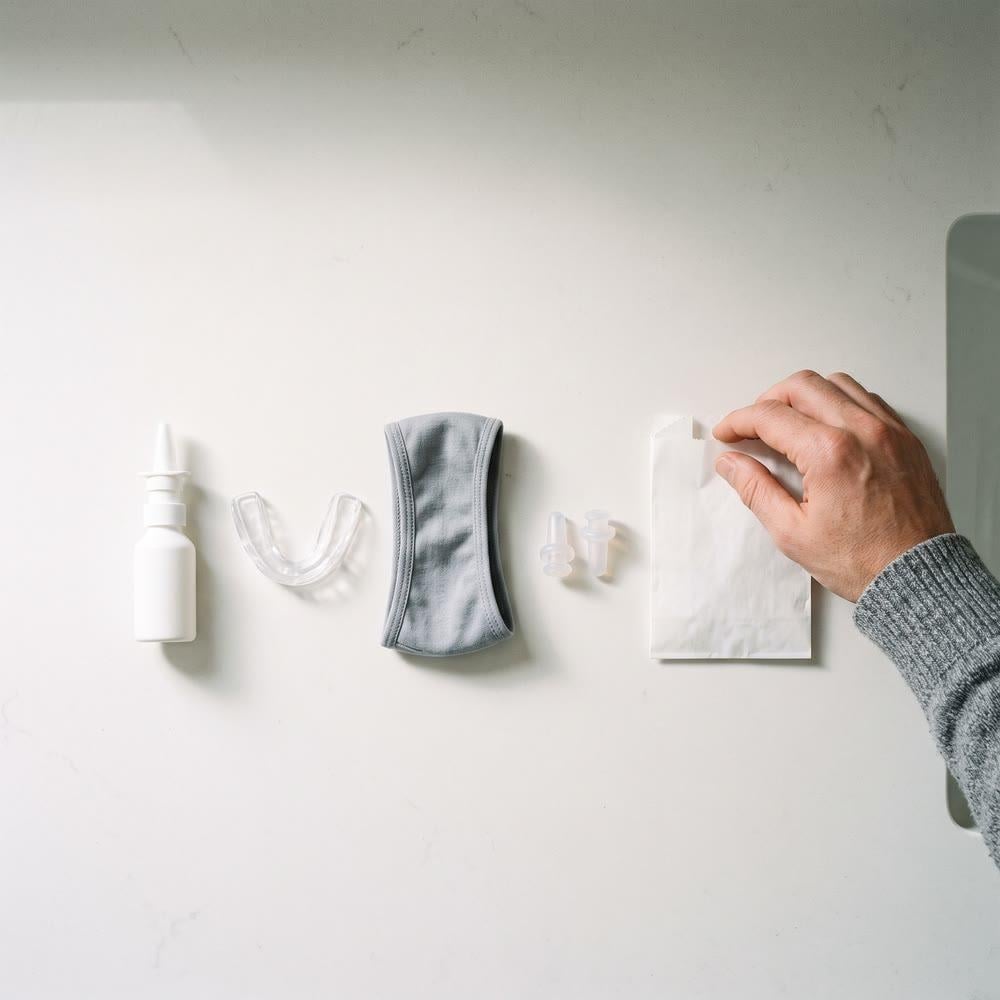
They suit nose-related snoring, not tongue, jaw or back-sleeping snoring. Breth nasal strips aren't a medicine and don't reduce swelling inside your nose; they help open your nasal airway while worn and help with snoring. Compare strips vs spray vs dilators and dilators vs strips.
Anti-snoring sprays, nasal sprays and rinses: what does each do?
Nose sprays and rinses act on the nose, not the tongue or jaw.
- Lubricating anti-snoring sprays: the medical sources we checked don't list them for snoring; ask your pharmacist.
- Decongestant spray: per the leaflet, usually no more than 3 days, never over 5 in a row; longer use can bring the blockage back stronger. Not under 6; pregnant or breastfeeding, ask a doctor. Ask a pharmacist first with heart, circulation, liver, kidney, thyroid or prostate problems, high blood pressure, diabetes, glaucoma or any medicine; some antidepressants with it can dangerously raise blood pressure. See nasal spray rebound.
- Steroid spray: for nasal allergy; ask a pharmacist first. It can take weeks of regular use; not over a month in a row without a doctor; pregnant women ask first.
- Saline rinse: only distilled, sterile, or boiled 3 to 5 minutes and cooled water, stored closed up to 24 hours; tap water can cause serious infections. Wash and dry the device; children only if a paediatrician advises.
Jaw devices for snoring: over-the-counter or dentist-fitted?
A mandibular advancement device holds the lower jaw and tongue forward. Medical sources say ready-made boil-and-bite ones aren't adjustable and tend to work less well than a dentist's adjustable ones: in a small trial, 91% of partners rated snoring much better with a custom device after 4 weeks, against 64% for a ready-made one in an older study. Side effects: early jaw discomfort, extra saliva, tooth movement and bite changes. Rule out apnea first and ask a dentist before long-term use.
Chin straps, sleep pillows and smart gadgets: worth it?
- Chin strap or lip shield: when your mouth falls open in sleep.
- Mouth taping: weak evidence for snoring; never tape your mouth with a blocked nose, chronic allergies, a sinus infection, large tonsils, a deviated septum or heart problems.
- Side sleeping: a tennis ball sewn into the back of your pyjama top, a pillow or a wedge. See the best sleeping position.
- Raising your head: pillows alone aren't enough; use blocks under the bed's head legs or a wedge.
- Electrical-pulse (EMS) devices, wristbands and smart gadgets: no reliable source we found supports them; get checked instead.
What is a CPAP machine, and do you need one?
CPAP pumps air through a mask over the nose, or nose and mouth, in sleep. Medical sources describe it as treatment for diagnosed apnea, rarely for snoring alone; it follows a sleep study, usually at home, and a doctor's follow-up. It's no impulse buy, prices vary, and a prescribed CPAP is never swapped for a pharmacy product.
So which suits your snoring? A step-by-step plan
- Start free: side sleeping, no sleeping pills (if prescribed, ask your doctor before stopping), weight loss if needed, no smoking.
- Then match the cause: nose: a strip or dilator. Mouth open: a chin strap. Back: a side-sleeping aid.
- Give it a fair try: a few weeks for a strip or aid; see when nasal strips don't help. Sprays don't get a few-week trial; keep their day limits above.
- Still snoring: a dentist for an adjustable jaw device, or an ENT or sleep doctor.
When does snoring need a doctor instead of the pharmacy?
See a doctor if:
- Your breathing stops and starts, someone hears you gasp or choke, or snoring is very loud every night.
- Daytime sleepiness, poor focus, mood swings or morning headaches.
- High blood pressure or obesity, or a neck over 43 cm in men or 40.5 cm in women.
- Changes and products haven't helped, or snoring affects you or your partner.
- Still blocked after 5 days of decongestant spray, or worse.
- Fever, nosebleeds or headaches after rinsing.
- Snoring that starts during pregnancy: tell your doctor.
- A child who snores: no adult products; see the paediatrician. See snoring in children.
Untreated apnea can be serious; don't drive drowsy. For advice, call 937 (Ministry of Health), 24/7.
FAQ
What's the best medicine for snoring at the pharmacy?
No reliable medical body we checked lists one; sprays treat a blocked nose. Ask your pharmacist.