
By the Breth Sleep and Breathing Team · Updated October 2026
Short answer: house dust allergy is most often dust mite allergy: tiny creatures in mattresses, pillows, carpets and sofas. Their droppings and remains cause sneezing, a blocked or runny nose and itchy eyes, often worst in bed, where mites gather. Weekly 60°C bedding washes, mite-proof covers and indoor humidity under 50% cut exposure. This article is information, not a diagnosis.
Key takeaways
- Dust mites don't bite; the problem is their droppings and remains.
- They gather most in the bedroom and the bed.
- Cough, wheeze or a tight chest at night: see a doctor.
What is dust mite allergy: the dust or the mites?
House dust mixes dust mites, cockroach particles, mould spores, pollen and pet dander. Mites are the commonest cause of house dust allergy, and symptoms can last all year. A mite has 8 legs, is about a quarter to a third of a millimetre long, eats shed skin flakes and doesn't bite. The allergy comes from proteins in its droppings and remains, which can cause symptoms weeks or months after it dies. Outdoor dust storms are a different issue; see blocked nose in dust storms.
What are the symptoms of dust mite allergy?
- Sneezing, an itchy nose, a blocked or runny nose.
- Itchy, red, watery eyes.
- Cough and an itchy roof of the mouth.
- With asthma: wheeze, chest tightness, breathlessness, night waking.
- It can worsen eczema.
The clue: symptoms at home and in bed more than outdoors.
Why is dust mite allergy worse in the bedroom and at night?
The bedroom usually has more mites than anywhere else at home. Allergens settle into fabric rather than floating, and most exposure happens during sleep, face on a pillow for hours. Making the bed or walking on carpet sends particles into the air. In the US, about 4 in 5 homes have mite allergen in at least one bed.
Do humidity, the AC and room humidifiers make dust mites worse?
Mites like warmth and high humidity, and decline when humidity stays below 50% consistently, not for one day. They can't survive very dry places like deserts, but indoor humidity is what counts. Check it with a hygrometer and keep it at 30 to 50%; AC and dehumidifiers help. If you use a room humidifier for a dry nose, keep humidity under 50%. See dry nose from the AC and the best bedroom temperature.
How do you get rid of dust mites in your bedroom? A practical checklist
These steps lower exposure, not a guaranteed fix; covers alone often aren't enough, so combine them.
- Wash bedding and pillowcases weekly at 60°C or higher, per the care label, and dry fully.
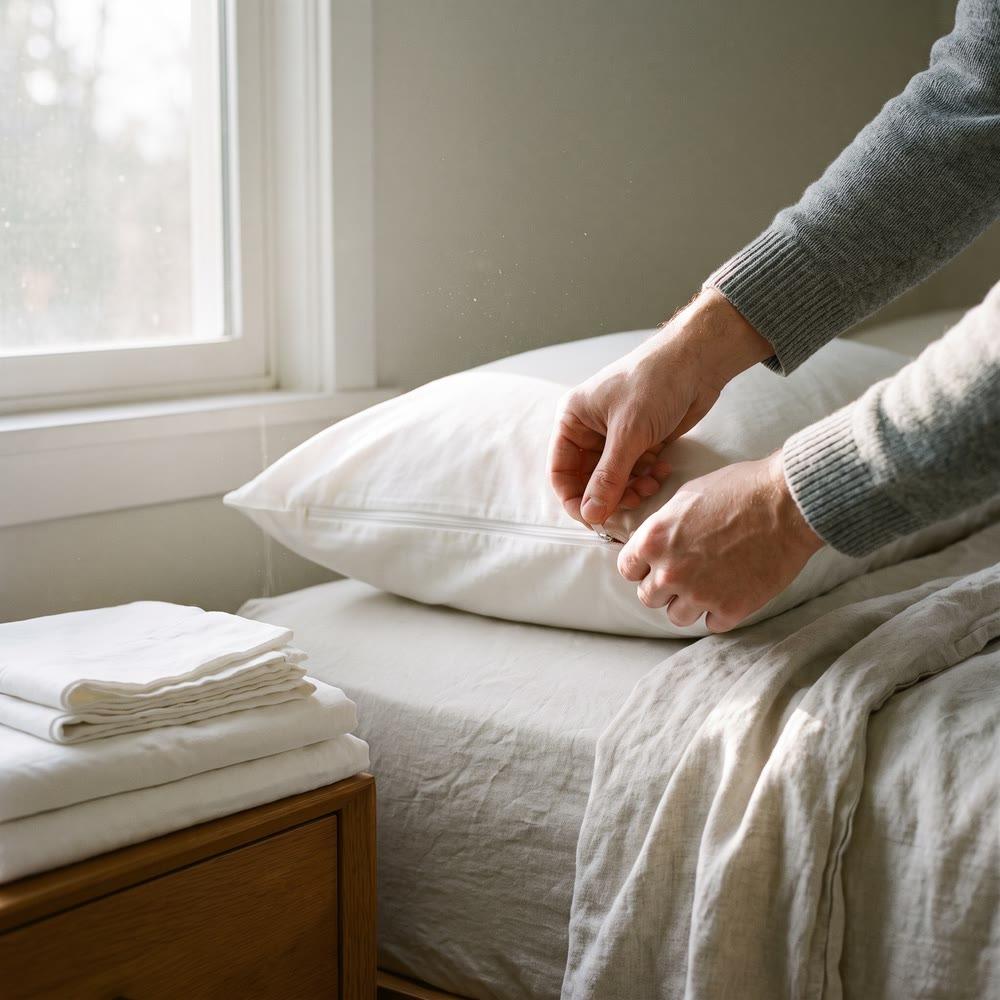
- Use zippered mite-proof covers on the mattress and pillows.
- Dust with a damp cloth; vacuum weekly with a HEPA-filter vacuum.
- Cut back on carpets, heavy curtains and stuffed toys; choose washable toys.
- Keep pets out of the bedroom.
- With central air, change the filter at least every 3 months.
- Replace pillows every 2 years.
- Clean while the allergic person is out, not at bedtime, in an N95-type mask.
- An air purifier covers a limited area, so keep it in the bedroom; avoid ozone or ionic devices.
Can dust mite allergy be cured?
There's no guaranteed cure; cutting exposure matters most, and medicines ease symptoms. Diagnosis is by skin-prick or blood test, and a positive result alone doesn't confirm allergy; a doctor matches it to your symptoms. Immunotherapy, shots or under-the-tongue tablets, can reduce sensitivity over time, only with a specialist.
What can a pharmacist or doctor offer?
- Options: antihistamines, steroid nasal sprays, saline sprays or rinses, decongestant sprays; the pharmacist or doctor chooses.
- Decongestant spray: follow the leaflet, usually no more than 3 days, never over 5 in a row; longer use can bring the blockage back. Not under 6; ages 6 to 11 only with a pharmacist; in pregnancy only if a doctor says. Ask a pharmacist first if you have high blood pressure, heart, circulation, thyroid, prostate, liver or kidney problems, glaucoma or diabetes, or take other medicines. Decongestant tablets don't suit breastfeeding.
- Rinses: only distilled, sterile, or boiled 3 to 5 minutes and cooled water, kept closed up to 24 hours; tap water can cause rare but serious infections. Fever, nosebleeds or headaches after: see a doctor. Children only on a paediatrician's advice.
- Pregnancy and breastfeeding: ask before any other medicine. No herb or supplement is recommended here.
When should you see a doctor about dust mite allergy?
See a doctor if:
- Symptoms worsen, affect sleep or daily life, the cause is unclear, or pharmacy treatments fail.
- Wheeze, chest tightness, breathlessness, or waking at night coughing or breathless: possible asthma.
- Asthma is getting worse, or you need your reliever inhaler more than usual.
- After any asthma attack, even if better: an appointment within 2 days.
- Facial pain or swelling with green or yellow mucus or fever, not better after 3 weeks or a week of pharmacy treatment, recurring, or in a child 11 or under.
- You think your child has an allergy.
Same day, if you have sinus symptoms and: feel very unwell, painkillers aren't helping, symptoms are worsening, you have weak immunity, or it's a child under 5.
Emergency, call 997: an asthma attack that worsens or doesn't ease with the reliever inhaler, or no inhaler; don't drive yourself.
For advice, call 937 (Ministry of Health), 24/7.
FAQ
Is dust allergy the same as nasal allergy?
Mites are a common cause of nasal allergy, which can last all year. See nasal allergy.
Can my child have dust mite allergy?
Yes; a doctor can test. Give no medicine without the paediatrician or pharmacist, and no decongestant spray under 6.
Why is my nose blocked at home but fine outside?
It may be mites in your bed and bedding, mould or pet dander; a doctor can confirm with tests.
From Breth
Breth nasal strips aren't a medicine and don't ease the allergy or swelling inside your nose. They help open your nasal airway while worn, are for adults, and don't replace a doctor.